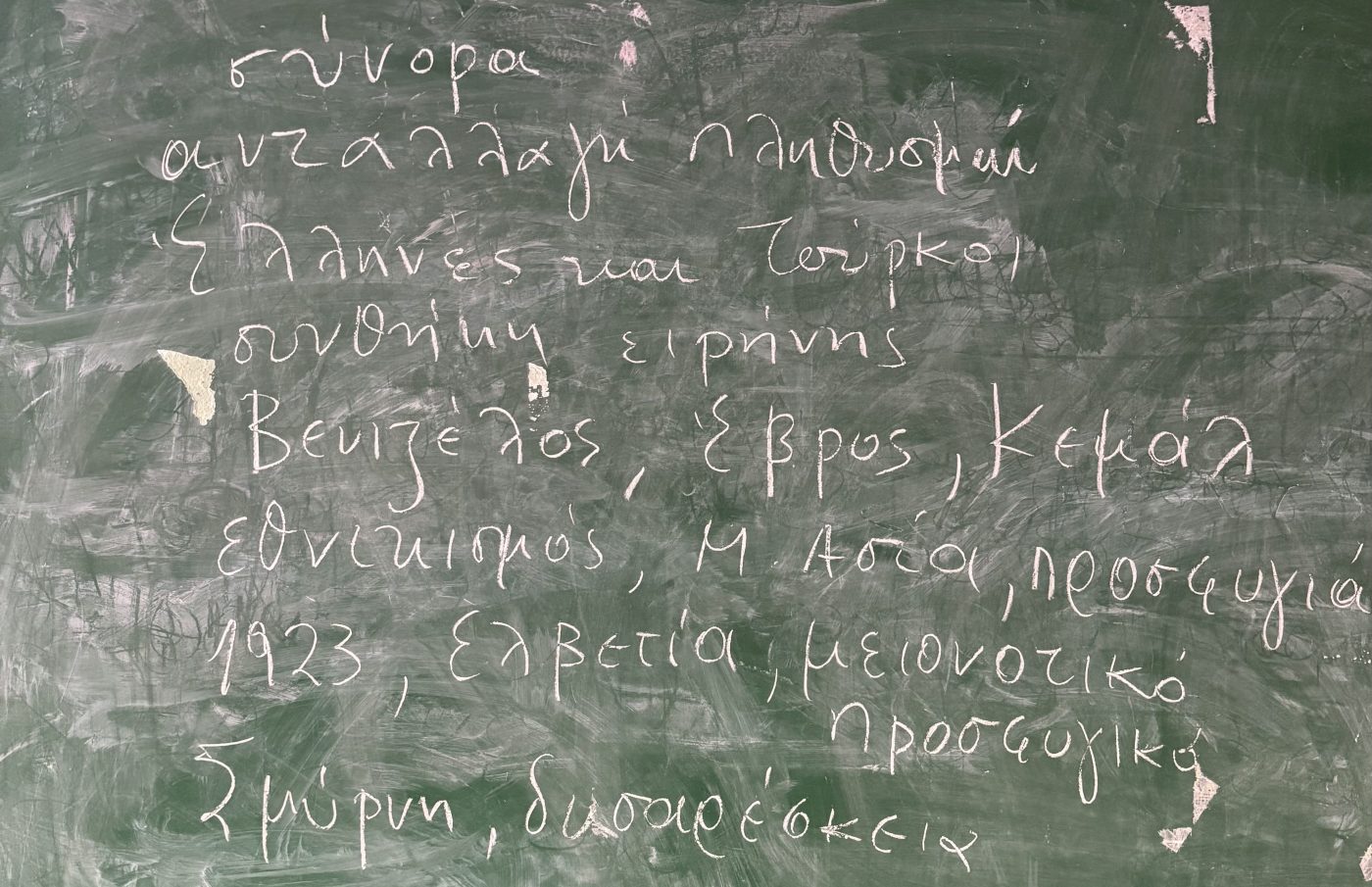

Georgios Giannakopoulos returns to his alma mater in Athens, to help lead a workshop in which local high school students debated what Lausanne meant to them.
Georgios is a TLP convenor.
Last month, two decades after I graduated, I returned to Panteion University to participate in a workshop with high school students reflecting on the legacies of the Lausanne Treaty and the population exchange. The workshop was organised jointly by TLP and the Association for History Education in Greece with the generous support of Panteion’s Research Centre for Modern History. As a graduate of Panteion, where I studied political science and history in the late 1990s and early 2000s, this return carried a special significance. A key aspect of my studies in Political Science and History at Panteion consisted of lectures and seminars led jointly by Greek and Turkish academics who critically reflected on difficult aspects of our shared past. This intellectual foundation instilled in me a deep appreciation for the complexities of historical memory and the importance of fostering dialogue across national and cultural divides.
The workshop took place at Panteion University on 23 November 2024 and brought together 35 high school students and ten history teachers from three adjacent high schools—two state schools and one private school—in a collaborative exploration of the Lausanne moment’s historical and contemporary implications. The aim was to engage Greek students in examining the history of the population exchange between Greece and Turkey and its enduring legacies, using innovative and interactive methods to connect them to this shared history.
Participants were welcomed by Dr Lambros Baltsiotis, representing Panteion’s Research Centre for Modern History, followed by a short introduction to TLP from me. Fellow TLP convenor Professor Angelos Palikidis followed with a question for the students to consider as a group, before being divided up into smaller groups: “What comes to mind when you hear the term “Lausanne Treaty”? This sparked an engaging conversation, grounding the students in the workshop’s theme. Palikidis then asked how many students’ families had histories connected to the population exchange. Twelve students raised their hands, revealing the deeply personal connections many had to this historical event. Some shared family stories: one described their grandparents’ journey from Asia Minor to Crete and Chios, while another recounted a similar migration to Thessaloniki. One student identified as having a refugee background, underscoring how the echoes of this history remain present in contemporary identities.
This workshop reaffirmed the relevance of Lausanne and the population exchange as lenses through which to explore broader issues of identity, displacement, and belonging. Combining historical analysis with creative expression and personal reflection, the students demonstrated a remarkable ability to engage with the complexities of a pivotal event in Greek and Turkish history, and illuminate its enduring legacies.
The students were divided into three mixed groups, each tackling activities that explored refugee memory and identity through creative and analytical tasks. We began by examining testimonies from both Greek and Turkish refugees, comparing and contrasting their experiences. One group created a role-play sketch in which a Turkish refugee from Crete and a Greek refugee from Turkey met in Ayvali/Ayvalik, reflecting on national belonging and the shared challenges of displacement. This exercise allowed students to humanize historical narratives and explore questions of identity and reconciliation.
Another group focused on the material culture of displacement. Drawing from artefacts featured on the TLP website, they discussed what items refugees might take with them when forced to flee and what these choices reveal about their social and cultural contexts. This sparked a broader conversation about the practical, symbolic and emotional significance of such objects and led some students to reflect on their own family histories of forced migration. A key theme emerged: whether the trauma of displacement is transmitted across generations, shaping identities even decades later.

TLP CONVENORS ANGELOS PALIKIDIS (L) AND GEORGIOS GIANNAKOPOULOS (R) WITH AHEG BOARD MEMBERS MARIA FRANGOULAKI, GIOULI CHRONOPOULOU AND IOANNA DEKATRI
A third activity encouraged students to synthesize meaning from testimonies through creative outputs. One group composed a poem that captured the essence of two different testimonies, blending perspectives into a shared narrative. This exercise highlighted the students’ ability to critically engage with historical sources while expressing their insights in creative, empathetical ways.
The day concluded with each group presenting their findings and creative outputs to all the others. These presentations revealed a number of common themes. Students had clearly reflected on how nationalism shaped the population exchange and its enduring consequences. They debated whether displaced populations retain a right to return. They discussed how refugees and their descendants are marked by their histories, across generartions. The Greek term ‘εντοπιότητα’ (entopiotita) denoting rootedness or belonging to a place, emerged as a central idea in discussions on identity and belonging,
This workshop reaffirmed the relevance of Lausanne and the population exchange as lenses through which to explore broader issues of identity, displacement, and belonging. By combining historical analysis with creative expression and personal reflection, the students demonstrated a remarkable ability to engage with the complexities of a pivotal event in Greek and Turkish history and illuminate its enduring legacies.
Blogposts are published by TLP for the purpose of encouraging informed debate on the legacies of the events surrounding the Lausanne Conference. The views expressed by participants do not necessarily represent the views or opinions of TLP, its partners, convenors or members.
 The Lausanne Project