

Gert Huskens writes about applying social network analysis to the history of sanitary internationalism.
Gert is a Postdoctoral Researcher at Ghent University.
“Doctor Dutrieux has never taken his task as sanitary delegate seriously, his absence will thus not cause a serious void within the Council.”[1]
In its session of 22 December 1883, the Sanitary, Maritime and Quarantine Council of Egypt [SMQE] said goodbye to Belgian delegate and ophthalmologist Dr Pierre-Joseph Dutrieux Bey. Clearly, his French co-delegate and vice-consul Alfred Guillois had not been impressed by Dutrieux’s performance. Yet Dutrieux had left his mark on Egyptian sanitary affairs. In the summer of 1883, the Belgian doctor had risen to the occasion. Following reports citing several cases of cholera in the port city of Damietta at the Mediterranean coast, Dutrieux had been given a high-profile task. After offering his services to the Egyptian government, Egyptian Prime Minister Sharif Pasha entrusted him with a scientific-sanitary mission to the epidemic’s epicentre in Lower Egypt and determine the origin of the outbreak. [2]
Dutrieux’ findings would put him centre stage in the sanitary debate surrounding the Fifth Cholera Pandemic (1881-1896).[4] Based on what he saw and heard, Dutrieux concluded that cholera was endemic to Egypt. As a result, Dutrieux lost faith in quarantine measures and promoted a more resolute local hygiene policy. Diplomatically, his anti-contagionist findings were also instrumentalised to serve the interests of the British Empire. Trying to disprove the theory that the disease had reached the country on a ship from Calcutta, and in an attempt to limit the impact on the Suez Canal’s commercial traffic, they had sent a mission led by surgeon-general in India William Guyer Hunter to Egypt.[5] Not only did Hunter “accidently meet” Dutrieux while visiting the Delta city of Sherbin, Hunter’s mission also reached the same conclusions about the endemic character of the disease.[6] In Hunter’s official report, presented to the British Parliament, Dutrieux and his investigations were cited in support of this anti-contagionist thesis.[6]
As a result, Dutrieux earned not only the ire of fellow delegates on the Sanitary Council who supported the contagionist thesis, such as Guillois, but also broader criticism. In his satirical journal Abou Naddara Zarqa Egyptian satirist in exile Yacub Sannu ridiculed Dutrieux alongside Hunter and the Italian Khedivial court physician Dr Onofrio Abbate.[8] The cartoon shows the grim reaper who prides himself on having taken “100.000” casualties before returning to India. In the foreground, a discussion takes place during which Hunter defends his claim that cholera is indeed endemic to Egypt. After admitting that the disease possibly had “a few drops of Asian blood in its veins”, Dutrieux responds “Oh! Hardly any!” Abbate on his turn even outrightly denies the presence of the disease. Collectively, Sannu refers to the clique as a bunch of “Jokers”. Within a few weeks, Dutrieux had become known as one of the most prominent pallbearers of the anti-contagionist faction in the sanitary public debate.

The 1883 cholera outbreak in Egypt has been perceived by historians as marking a shift from an international regime of sanitary internationalism towards the establishment of a British colonial medical regime.[9] At first sight the story of Dutrieux challenges this narrative. His actions can hardly be characterised as having been steered by London’s diplomatic and commercial interests. Yet, the Belgian diplomatic archives also remain silent about any possible instructions Dutrieux received from the Belgian Foreign Ministry or diplomats stationed in Egypt. The question therefore remains how an obscure Belgian ophthalmologist with little to no background in sanitary medicine could rise to prominence in a scientific debate with such a global impact. Why did Sharif Pasha entrust him with this mission in the first place? In this blog, I will demonstrate that a part of the answer to that question can be found by offering a bird’s eye view of his position in the network of Egypt’s sanitary institutions. Applying social network analysis to the history of sanitary internationalism, I will provide a deeper insight into the actors and networks shaping the international playing field facing a cholera outbreak that changed the world’s response to epidemic diseases.
The Facts (and what they tell us)
Following his graduation at Ghent University’s Medicine Faculty in 1872, complementary studies in ophthalmology in Paris, and service in the Belgian army, Dr Pierre-Joseph Dutrieux established himself as an ophthalmologist in Egypt around 1873. He had an unremarkable career in the country until his medical expertise was called upon by Belgian King Leopold II’s Association internationale africaine in 1878. Attached to the Expedition Cambier-Crespel, Dutrieux participated in the very first Belgian scientific-colonialist expedition into what later would became the Congo-Free State.[10] Upon his return, he published the first version of his study on the effects of the tropical climate on European explorers and toured the learned societies of Europe. [11] Egypt nevertheless called again. In 1880, Dutrieux joined the Khedivial government’s Anti-Slavery Department as a secretary, but after a just few months he returned to ophthalmology, this time at the European Hospital of Alexandria.[12]

While Dutrieux had explored other professional career paths, the institutional landscape of public health in Egypt had changed drastically. From an international point of view, the Intendance Générale Sanitaire had been the country’s foremost sanitary board since 1849. Dating back to 1831, this sanitary council was nominally dominated by delegates of the foreign powers, but presided over by foreign doctors representing the Egyptian authorities. After Belgium lost its position on the sanitary board with the abolishment of the Consular Committee of Health in 1839, it reclaimed its seat at the table in June 1869, only a few months before the opening of the Suez Canal.[12] For over a decade, Belgium tasked the chancellor of the Alexandria consulate with representing it on the council, before turning in 1879 to Dr Nitard-Ricord, cousin of Napoleon III’s consulting surgeon Phillippe Ricord.[14] In 1881, the Khedivial government divided up the board’s remit in an attempt to counter calls for further internationalisation of Egypt’s sanitary affairs. Maritime and external aspects of sanitary policy remained the responsibility of the international council, renamed the Sanitary, Maritime and Quarantine Council of Egypt. Internal sanitary affairs were handed to the newly-established Council of Public Health and Hygiene (CPHH) and assure the local authorities a stronger grip on the issue.[15]
Only a few months after this reform, on 21 June 1881 Dutrieux assisted the meeting of the Sanitary, Maritime and Quarantine Council of Egypt for the first time as Belgium’s delegate. [16] While the reasons for Dutrieux’ selection are unknown, budgetary restraints, his previous services to the Belgian King and the absence of any other Belgian doctor in Egypt surely positioned him well. Within a few months, Dutrieux reaped the fruits of his new prominence in Alexandria’s sanitary affairs. In October 1881, the Khedivial government appointed him as ophthalmologist in the Alexandria Government Hospital.[16] From then onwards, the French delegate in the Sanitary Council noticed his regular and repeated absence from the meetings of the Sanitary, Maritime and Quarantine Council of Egypt.[17] Had he used the Council as a stepping-stone for his own career? In 1882, Dutrieux’ name pops up again in European press. During the British bombardment of Alexandria that quelled the ‘Urabi Revolt and ultimately announced the establishment of a British protectorate over Egypt, he had not left his post at the Alexandria hospital. After the guns fell silent, the Khedive made Dutrieux a member of the central sanitary commission charged with safeguarding the sanitary safety of the war-torn city. For his services, the Khedive rewarded him not only with promotion to chief physician of the Government Hospital, but also with the title of Bey.[18]
The above biography of Dutrieux illustrates the relatively short route Dutrieux took to a position where he combined his role as Belgian delegate in the SMQE with positions in foreign and local health institutions. Yet two questions remain unanswered. First of all, how did the 1881 institutional reform impact the position of Belgium in the SMQE? Secondly, what was the relative position of Dutrieux vis-à-vis other members of Egypt’s sanitary community. This is where social network analysis can help.[19]
Graphs (and how to make them)
The type of network best suited to investigating Dutrieux is what historical network visualisation expert Martin Grandjean calls an “extracted network”. This is a “network extracted from the contents of a well-defined and homogeneous corpus of documents, often presented as a list (or transformed into a list) and modelled as a bipartite graph (that can be projected into a one-mode network).[20] Or, to put this in language historians might use, it connects actors to institutions within a well-defined timeframe. In the French Diplomatic Archives in Nantes, I was lucky to I discover exactly this type of relational data. First of all, I found a full overview of the composition of the board in 1879 in a publication on the history of theIntendance Générale Sanitaire. [21] Secondly, I encountered a set of highly informative annotated tables annexed to the reports of French delegate Guillois. [22] These disclose the composition of the Sanitary, Maritime and Quarantine Council of Egypt between 1881 and 1884 and provided me with short overviews of the individual members’ other affiliations in Egypt’s health institutions in Egypt. As these tables were drafted as part of chain of communication lamenting the growing British influence on the SMQE, this information was crosschecked with the help of a series of medical journals, medical treatises, annuaries, yearbooks and newspaper articles. Two reports in the British Medical Journal and the Revue d’hygiène et de médécine preventive published in August 1883 were of particular relevance. Once the data in these sources is stitched together, it provides a detailed snapshot of Egypt’s sanitary playing field during the height of the 1883 outbreak. [23]

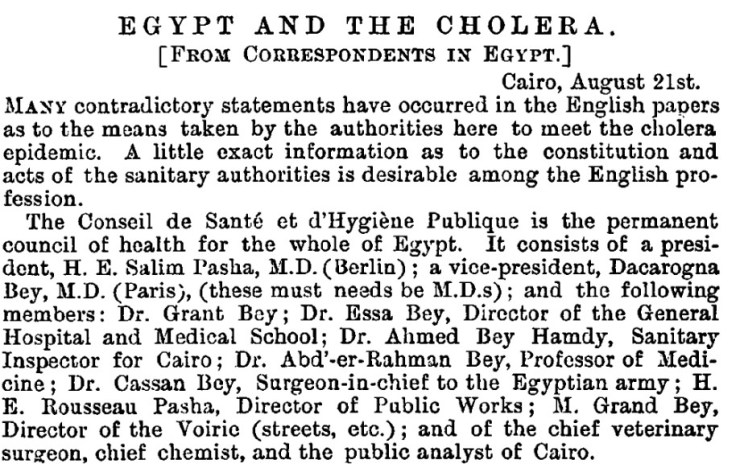
“BULLETIN ÉPIDÉMIOLOGIQUE – LE CHOLÉRA,” REVUE D’HYGIÈNE ET DE MÉDÉCINE PREVENTIVE 5 (1883): 789-790
In order to translate this information then into relational data, I made use of the open-source database builder Heurist. Aiming for a two-mode network displaying the institutions of sanitary internationalism in Egypt and their members, I created records for the actors, the institutions and related them to each other.[24] In the network panel that Heurist provides, this already gives a preliminary insight into the most important clusters, actors with a so-called “bridging” position and the general distribution of actors and institutions.

THE INTERNATIONAL SANITARY INSTITUTIONAL PLAYING FIELD IN EGYPT, 1879. LAYOUT: HEURIST
In order to improve the readability of the graphs, the data was subsequently exported as Gephi file and imported into Gephi as an undirected graph. Often referred to as “photoshop for networks”, Gephi is currently the most popular and most intuitive software package to generate and edit networks.[25] I opted for the ForceAtlas 2 algorithm, Gephi’s default, to spatialize the nodes and chose the sleek Default Straight basic pre-set.[26] First of all, I cleaned the data in the Data Laboratory in the Node paneluntil I only had two types of nodes: actors and entities. I could now generate a clearer overview of the actors involved by differentiating them. First of all, I wanted to get an idea of the distribution of actors representing foreign states and those representing the Egyptian state in the SMQE, as well as the actors attached to the Council of Health and Public Hygiene. I added a new column Representing in the Data Laboratory and assigned the actors and states a value accordingly. In the Appearance menu, the nodes then were given a colour accordingly with the Partition function. As a result, the difference foreign delegates (dark blue) representing the foreign states (light blue) on the one hand, the supposedly neutral president (green) and the Egyptian delegates in the SMQE (red) and the Egyptian delegates in the Council of Health and Public Hygiene (burgundy) representing Egypt (pink) on the other, immediately stood out more sharply.
I also wanted to see the difference between the different types of actors. I distinguished four types: doctors, diplomats, state officials and one lawyer. Thanks to the Polygon Shaped Nodes plug-in, I could give the different nodes representing these types of actors a different shape.[27] After adding a new Integer type column in the Data Laboratory I assigned each node representing an actor a value accordingly (3, triangle, 4 for square, 5 for pentagon, 6 for hexagon). Respectively, the doctors, diplomats state officials and lawyer were now shaped as a triangle, square, pentagon and hexagon. To conclude, I wanted to tweak one more thing. Two of the delegates, British delegate Dr James Mackie and French delegates Dr Charles Gaillardot and Dr Chaumery, were not full members of the SMQE, but honorary members without voting rights. How could I include them without suggesting they had the same role and rights as the other nodes? Rather than attributing them a special colour or node shape as that would render the network too difficult to read, I edited the edge connecting their respective nodes to the SMQE node. In the Data Laboratory’s Data Panel displaying the Edges, the weight for these specific edges was adjust to 0.5. As a result, the line connecting them with the SMQE was displayed half as thick.
The last thing I needed to adjust were some visual settings. In the Layout panel, I put the Scaling on 8000 and also opted for Stronger Gravity. This is a very intuitive choice. You play around with this value until you have no overlapping nodes and are able to distinguish the different edges. At the same time you also don’t want a network that is too spaced out. The same applies to the node size. In the Appearance panel, the node size was determined by Ranking them according to their Degree. This implies that nodes are sized according to the amount of connections they have. I put the Min size on 110 and the Max size on 300. Finally, I turned to the Preview window and turned off Show Label. The labels of the different nodes are no longer displayed which gives a sleek visual network. The last thing I now needed to do was turn this graph into an informative visualisation. First of all, I added three types of tags to the nodes (Arabic numerals to states, Roman numerals to institutions, letters to actors) in Adobe Photoshop. In order to keep to graph as readable as possible, I only added tags to the institutions and actors that are relevant for the analysis of the Dutrieux case. To conclude, I added the key.
The Visualisations (and how to read them)
The visualisations I produced, give a general overview on the position of the Sanitary, Maritime and Quarantine Council of Egypt in the network of health and sanitary institutions through the affiliations of its members, both in 1879 and in 1883.

THE INTERNATIONAL SANITARY INSTITUTIONAL PLAYING FIELD IN EGYPT, 1879. LAYOUT: FORCEATLAS2 (GEPHI)

At a single glance, one can see on the 1879 and 1883 visualisations
1) The states represented in the SMQE
2) The type of actors every state delegated to the SMQE
3) The relative share of doctors, diplomats and state officials delegated to the SMQE
4) The health institutions to which the doctors in the SMQE were affiliated
On the 1883 visualisation, one can see:
5) The type of actors the Egyptian government delegated to the CPHH
6) Which actors were delegates to both the SMQE and the CPHH
7) The role the health institutions played in connecting the SMQE and CPHH through actors having shared memberships.
The first visualisation displaying the international sanitary institutional playing field in 1879, shows the relatively marginal position of the Belgian (9) delegate (A) before the 1881 reform. Much like the other delegates, both diplomats and doctors, the Belgian delegate had no affiliations to other health institutions. Apart from honorary delegates for the United Kingdom (12) and France (2), Dr James Mackie (B) and Dr Charles Gaillardot (C), only Russian (13) delegate Johannes Schiess Bey (D) was embedded into the network of local health institutions.But what does it tell us about Dr Dutrieux?
The key takeaway of the second visualisation is that Dutrieux was the foreign delegate in the SMQE (I) who was institutionally the most embedded in the network of Egyptian state-affiliated health institutions. This intuitive visual suggestion that Dutrieux was an actor connecting the different parts of the network is also statistically underpinned. After calculating the “betweenness centrality”, which measures how often a node appears on shortest paths between nodes in the network, Dutrieux is the actor with the single highest value. The combination of his positions at the Qasr El-Eyni Medical School of Cairo (IV) as well as Government Hospital of Alexandria (V) and the European Hospital (VI) as well as his membership of the SMQE is not only unique, it made him a real intermediary in the sanitary world of Egypt. No other delegate in the SMQE had a profile that came close to Dutrieux’. Dr Chaumery (C) and Dr Mackie (D), the honorary members for France (3) and the United Kingdom (4) respectively, also were affiliated to a local health institutions, but did not have the right to vote. Delegate for Austria-Hungary (15) Andreas von Klodzianowski (B) worked for the Egyptian government as a doctor, but was not attached to a hospital. To a certain degree, the visualisation even has predictive value. Dr Johannes Schiess Bey (E), the foreign doctor closest to Dutrieux as the sole representative of Russia (15), later switched his allegiance and would represent the Egyptian government from 1884 onwards.
I argue that it was due to Dutrieux’ institutional ties and independence as delegate for Belgium (2) in the SMQE that Sharif Pasha selected him to conduct the Egyptian government’s scientific-sanitary mission. In combination with his proven track record serving the Egyptian state, this position made him the most eligible candidate for such a task. Especially if one recognizes that Dr Salem Pasha (F), president of the CPHH (II), was a staunch contagionist who did not support the endemic thesis, this choice makes only more sense. In the French-leaning newspaper Le Bosphore Égyptien that pushed a contagionist narrative, Tigrane Pasha, the Egyptian Ministry of Foreign Affairs’ secretary-general was cited as the CPHH’s fiercest pro-British adversary of the CPHH.[28] Representing only a minor power in the sanitary council, unhindered by extensive sanitary expertise or contagionanist sympathies as an ophthalmologist and having served the Egyptian government loyally in the years before, Dutrieux was the right man on the spot in 1883. Dutrieux and his findings should in this regard not be perceived as the official position of the Belgian government in the SMQE, but rather as the product of Dutrieux’ collaboration with the Egyptian authorities. Even though Dutrieux was criticized fiercely by his peers and ridiculed in the press, the Egyptian government after all decided to publish his anti-contagionist findings in its gazette Le Moniteur Égyptien.[29] As a result, it appears that Dutrieux’ report was the Egyptian government’s attempt to play into the British occupational authorities’ anti-contagionist position. Or, as Le Bosphore Égyptien put it: “What we have read, is the fruit of the collaboration between doctor Dutrieux and Tigrane Pasha”.[30]
Conclusion
It is a difficult task to find a historian who will disagree that certain networks played a crucial role in shaping the past. Yet historians are often hesitant to perform full-fledged network analysis. With this blog I have tried to show something of what this method has to offer for the history of nineteenth-century international relations. For other historians who want to join me in experimenting with applying social network analysis to their own research, I have four rules of thumb.
1) Keep your eyes open for relational data: Relational data is everywhere. Much, if not all, depends on the data one finds, aggregates and stores. For this blog, I relied to a large extent on the tables found in French diplomatic correspondence, but they can also be found elsewhere. Think of proceedings, statutes, the frontispiece of a publication, newspaper articles, pictures, annuaries … the possibilities are endless.
2) Be pragmatic: You will never be able to put all the information you have into a visualisation (and you don’t want to anyway). Make clear choices in the data you want to display. In my case, I chose not to show the memberships with learned societies, as my focus was on the SMQE, the CPHH and the health institutions. If I had displayed more, it would have rendered the visualisation completely unreadable. Keep your final design as sleek and clean as possible.
3) Visualisations do not speak for themselves: Like a picture, a visualisation is worth a thousand words. This does not however imply that no words are needed to explain your visualisation. Focus on specific nodes or clusters that support your argument and don’t be afraid to leave irrelevant parts of the network unmentioned. Do not treat your network as a sterile reflection of data, but integrate it into its historical context.
4) From sources to networks and back: Do not look at visualisations merely as end products. Instead, use your graphs to reassess your source material. Let the visualisations inspire you to change your focus and zoom in on actors or institutions you left unacknowledged before.
Notes
This blog was written as part of my research at Fighting Pandemics from Below, 1792 – 1942 project at Utrecht University. This project has received funding from the European Research Council (ERC) under the European Union’s Horizon 2020 research and innovation programme (grant agreement n° 101125306).
[1] CADN, FR MAE 353PO2 293, Alfred-Charles-St Edme Guillois to Lucien Monge, Alexandria, 24 December 1883.
[2] Pierre-Joseph Dutrieux, Le choléra dans la Basse-Egypte en 1883. Relation d’une exploration médicale dans le Delta du Nil pendant l’épidémie cholérique (O. Berthier, 1884): 6–11.
[3] An anecdotal reference to Dutrieux can be found in: Sylvia Chiffolau, Genèse de la santé publique internationale. De la peste d’Orient à l’OMS (Presses Universitaires de Rennes, 2012), 107.
[4] Christopher S. Rose, “Trial by Virus: Colonial Medicine and the 1883 Cholera in Egypt,” Journal of Colonialism and Colonial History 24, no. 1 (2023).
[5] William Guyer Hunter, “Remarks on the Epidemic of Cholera in Egypt,” British Medical Journal 1203, no.1 (19 January 1884): 91–6.
[6] United Kingdom. Parliament, Correspondence Respecting the Cholera Epidemic in Egypt: 1883, Commercial. No. 34., C. 3783, 1883: 57; United Kingdom, Parliament, Further Correspondence Respecting the Cholera Epidemic in Egypt: 1883, Commercial. No. 34. (Continuation)., C. 3788, 1883: 3–4 ; 39.
[7] Abu Naddara Zarqa 7, no. 19 (15 September 1883): 4.
[8] Rose, “Trial by Virus”; Chiffolau, Genèse de la santé publique internationale, 104–9.
[9] A. Lacroix, “Dutrieux (Pierre),” Biographie Coloniale Belge 1 (Institut royal colonial belge, 1948): 352 ; J. M. Jadot, “Dutrieux (Pierre-Joseph),” Biographie Coloniale Belge 4 (Institut royal colonial belge, 1950): 270 ;
[10] Pierre-Joseph Dutrieux, La question africaine au point de vue commercial par le docteur Dutrieux, ex-médecin de l’expédition internationale africaine. Conférences données à l’Union Syndicale de Bruxelles dans les séances du 9 et du 23 mars 1880 (A.-N. Lebègue et Compagnie, 1880); Pierre-Joseph Dutrieux. Contribution à l’étude des maladies et de l’acclimatement des Européens dans l’Afrique intertropicale (Vanderhaeghen, 1880) ; J. M. Jadot, “Un Tournaisien, médecin de l’A. I. A. — J. P. Dutrieux,” Bulletin des Séances de l’Institut royal colonal belge 21, no. 2 1(1950) : 350–370.
[11] “Count Della Sala and Dr. Dutrieux,” The Anti-slavery reporter 22, no. 5 (November 1880): 128; “Extract of a letter adressed by Count Della Sala to H. E. Riaz Pacha,” The Anti-slavery reporter 22, vol. 4, no. 1 (January 1881): 3–4; Moniteur belge: journal officiel (14 October 1881): 3736
[12] Gert Huskens, “The Lion and the Sphinx. An entangled history of Belgian diplomacy in Egypt, 1830-1914,” (PhD thesis, Université libre de Bruxelles and Ghent University, 2023),124–130; Tasos Neroutsos, Exposé Historique des Attributions des Délégués Consulaires accrédités auprès du Conseil International de l’Intendance Générale Sanitaire d’Egypte par le Président par Intérim Néroutsos Bey (Extrait du procès-verbal de la Séance du 18 Mars (1879): 28
[13] Tasos Neroutsos, Extrait d’une notice sur l’organisation actuelle de l’Intendance Générale Sanitaire d’Egypte par le Président par Intérim Néroutsos Bey (A. Mourès, 1879): 12.
[14] Chiffolau, Genèse de la santé publique internationale, 110.
[15] CADN, FR MAE 353PO2 290, Alfred-Charles-St Edme Guillois to Lucien Monge, Tableau annexé à la note du 4 Mai 1882, 4 May 1882.
[16] Moniteur belge: journal officiel (14 October 1881): 3736.
[17] Ibid.
[18] L’Indépendance belge 53, no. 211 (30 July 1882): 2; Moniteur belge: journal officiel (8 August 1882): 3056.
[19] For a good introduction to what social network analysis has to offer see Martin Grandjean, Introduction to Social Network Analysis: Basics and Historical Specificities, HNR+ResHist Conference , 30 June 2021.
[20] Martin Grandjean, “Analisi e visualizzazioni delle reti in storia. L’esempio della cooperazione intellettuale della Società delle Nazioni,” Memoria e Ricerca, Rivista di storia contemporanea 2 (2017): 371–393.
[21] Tasos Neroutsos, Extrait d’une notice sur l’organisation actuelle de l’Intendance Générale Sanitaire d’Egypte par le Président par Intérim Néroutsos Bey (A. Mourès, 1879): 12.
[22] CADN, FR MAE 353PO2 293, Guillois to Alexandre Dobignie, annex, Alexandria, 23 April 1881 ; CADN, FR MAE 353PO2 290, Alfred-Charles-St Edme Guillois to Lucien Monge, Tableau des Séances du Conseil Sanitaire Maritime et Quarantenaire d’Egypte du 18 Janvier 1881 au 15 Avril 1882, Alexandria, 10 May 1882; CADN, FR MAE 353PO2 293, Guillois to Camille Barrère, Tableau annexé à la note du 4 Mai 1882. Composition au Mois de Mai 1882. Composition actuelle du Conseil (Mai 1884), Alexandria, May 1884.
[23] “Bulletin épidémiologique – Le Choléra,” Revue d’hygiène et de médécine preventive 5 (1883): 789-790 ; “Egypt and the Cholera. [From Correspondents in Egypt.],” British Medical Journal 2, no. 1182 (25 August 1883): 391-393.
[24] For a five-part tutorial to set-up your own Heurist database, see: https://www.youtube.com/watch?v=-lRjmkpQh4g&list=PLnpUV3fVROXjO_FFDb8K4L6UoQfnhVkqQ
[25] For an introduction to Gephi, see: https://www.martingrandjean.ch/gephi-introduction/
[26] M. Jacomy, T. Venturini, S. Heymann, & M. Bastian, “ForceAtlas2, a continuous graph layout algorithm for handy network visualization designed for the Gephi software,” PloS one 9, no. 6 (2014): e98679.
[27] For an introduction to the Polygon Shaped Nodes plugin see: https://www.youtube.com/watch?v=TnEPUNsjEUU
[28] “Encore une commission,” Le Bosphore Égyptien. Journal quotidien du Caire et de Port-Said 6, no. 518 (10 October 1883): 1.
[29] “Chronique intérieure,” Le Bosphore Égyptien. Journal quotidien du Caire et de Port-Said 6, no. 518 (10 October 1883): 2.
[30] Le Bosphore Égyptien. Journal quotidien du Caire et de Port-Said 6, no. 522 (15 October 1883): 1–2.
MAIN IMAGE: ROYAL LIBRARY OF BELGIUM, III 1876/LXVI/168, DEATH NOTICE OF PIERRE-JOSEPH DUTRIEUX BEY, 30 JANUARY 1889.
 The Lausanne Project