
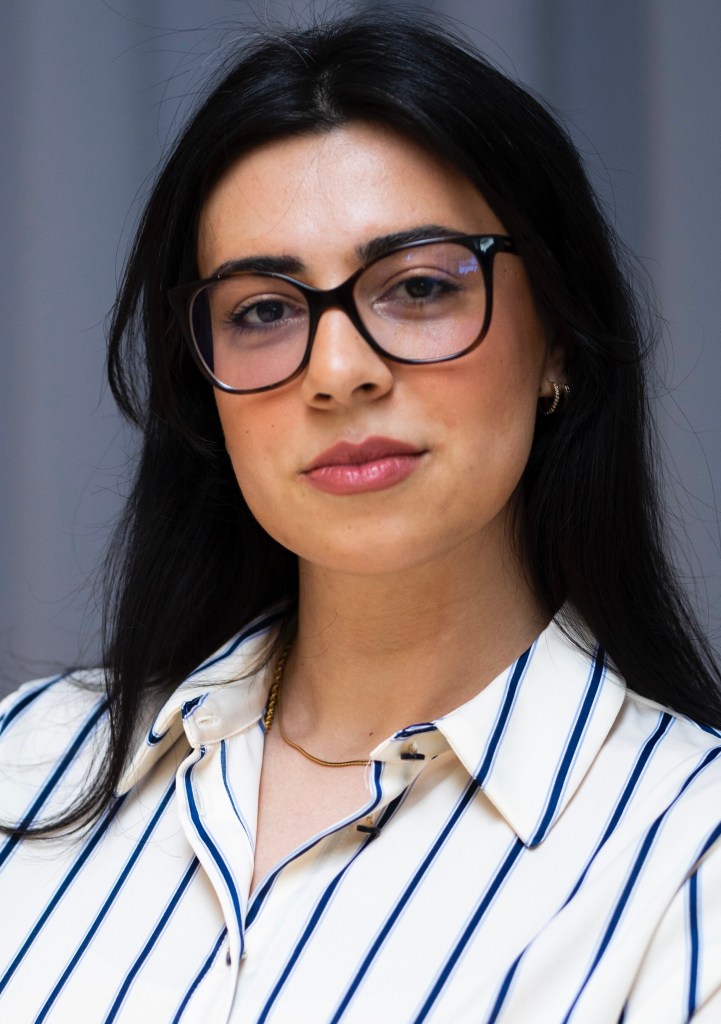
Sinem Arslan shares her reflections on last week’s conference, held at the Justus Liebig University in Giessen, on the legacies of the Lausanne population exchange.
Sinem is a PhD candidate at Boğaziçi University.
In 2022, when I began my PhD, I enrolled in an ethnography course requiring independent fieldwork. Having completed a master’s thesis on the associational life of Turkish migrants from Bulgaria in Turkey, I initially planned to continue working with the same community. Yet my positionality as a first-generation migrant and my sustained engagement had produced what ethnographers call “over-rapport,” a proximity that risks blurring analytic distance. This reflexive moment led me to reconsider my research design and seek greater methodological distance. I decided to work with a different group. But which group and with what question?
Around this time Turkey was preparing for the 2023 presidential and parliamentary elections. Political parties had already begun crafting their discourses. It was during this moment that I became aware of a group of exchanged descendants in the Kayabaşı neighborhood of Istanbul’s Başakşehir district. There, residents were engaged in a legal struggle against dispossession and displacement triggered by neoliberal urban transformation projects, most notably TOKİ housing developments and the Canal Istanbul mega-project. Their resistance was organized through the Kayabaşı Selanikliler Association and articulated explicitly around an “exchanged” identity. This struggle sparked a number of questions. I began to trace the ghost of the 1923 Population Exchange in Kayabaşı, once the Greek Orthodox village of Aya Yorgi, as descendants of refugees confronted contemporary forms of state and market power. Yet one question persisted: after the elections, did the villagers continue to resist in the same way?
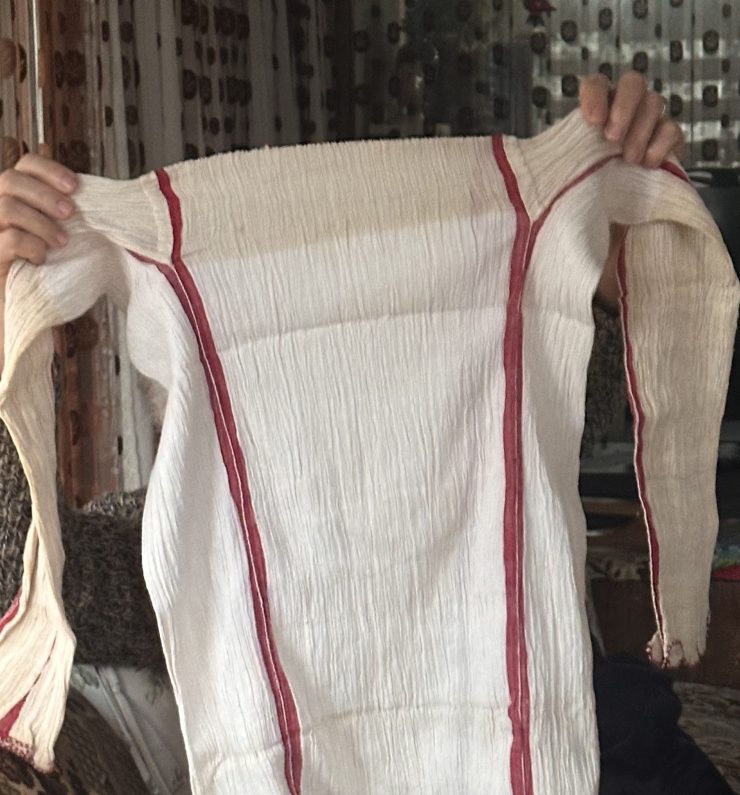
To explore this question, I returned to the field in 2024. The outcome was an article (currently under submission) entitled “The Displacement of Displacement: Remembering the Lost Homeland in the Shadow of Canal Istanbul.” I presented a version of this article at the Giessen conference. Yet the conference offered more than feedback. Two weeks earlier, I had discarded a seventy-year-old undershirt my grandmother had brought from Bulgaria and wondered why it was called a “Shirt from Peloponnesus.” In Giessen, that question found its answer.
Keys to Memory
The conference started with a keynote speech by Erik-Jan Zürcher and continued with performative narrations by Christina Dongas and Remziye Koşar Yiğit, whose families had experienced the Population Exchange from opposite sides. By foregrounding place, their narratives highlighted both convergences and divergences in how exchange memory is transmitted in Greek and Turkish contexts. Over the following two days, participants presented thirty-one papers, alongside projects such the Istanbul Merchants Project, Memory Izmir Project and TLP itself. The screening of Kerem Soyyılmaz’ film Searching for Rodakis further extended discussions on memory, loss, and return. Alongside historians like me, the participants came from a wide range of disciplines. This diversity enriched the discussion and broadened perspectives on the Population Exchange.
Prevailing narratives often reduce the Population Exchange to a Turkish–Greek binary. The conference served as a reminder that displaced communities were internally heterogeneous, with varied experiences and divergent modes of remembering. Moreover, the presentations revealed a discernible asymmetry: within the Turkish context, the material culture of refugees from Greece appears relatively underrepresented in existing scholarship. In contrast, Pari Argyrakaki’s paper on memorative objects demonstrated how Orthodox refugees who left Anatolia brought the keys to their homes and preserved them across generations. These keys function not merely as objects, but as condensed archives of belonging. Her presentation prompted me to wonder whether different ethno-religious groups, though displaced under the same agreement, might have imagined “home” in fundamentally different ways. Can the meaning of home ever be universal?
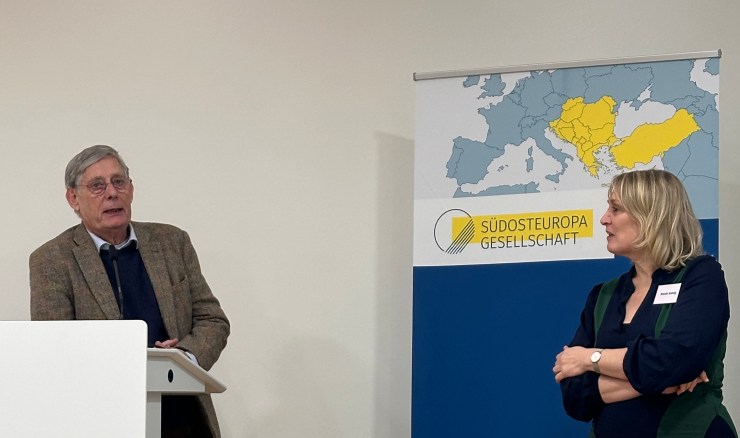
ERIK-JAN ZÜRCHER AND CONFERENCE CO-ORGANIZER NICOLE IMMIG
Perhaps similar material cultures exist among Muslim refugees in Turkey. But institutions dedicated specifically to the Population Exchange remain scarce in Turkey. Chrysoula Anagnostopoulou’s paper addressed this asymmetry directly, exploring how museums established by refugees from Anatolia, and their curatorial practices, reveal distinct strategies of preservation and representation. Just as the icons addressed by Kyriaki Tsesmeloglou function as vessels of remembrance, the differing meanings attributed to death and burial in Islam and Christianity shape how displacement is remembered and materialized. This divergence became even more apparent in a paper by Leonidas Karakatsanis and Ülker Başak Yeşilkaya, that examined the necropolitics of memory surrounding human remains and burial sites, particularly a Muslim cemetery in Panagitsa.
Sound Tracks
Among the many reflections on the politics of remembering, one presentation that particularly moved me was Alexandra Mourgou’s research on rebetiko. Tracing the migration of music alongside the migration of people, her study illuminated the layered intersections of identity, class, and historical transformation embedded within this genre. It led me to think about how easily we focus on visible political arenas while overlooking how profoundly political everyday life and so-called “cultural” domains can be. Music, in this sense, emerges not as a passive backdrop but as a medium through which memory is preserved, negotiated, and transmitted. Even beyond lyrics or explicit narratives, rhythm itself carries affect. One does not need to understand the lyrics to feel resonances of collective trauma and inherited memory. Indeed, while writing this post, I found unexpected inspiration in Zafeiris Melas’s 2015 album İki Yaka / Δυο Πλευρές, which means “two shores” in English. I listened to it from beginning to end as I reflected on the shared rhythms and divergences embedded in exchange memory. If you, too, wish to hear the cadence of both commonality and difference that runs through the memory of the Population Exchange, I invite you to listen to this album.
For the programme of the conference, including abstracts, click here.
Blogposts are published by TLP for the purpose of encouraging informed debate on the legacies of the events surrounding the Lausanne Conference. The views expressed by participants do not necessarily represent the views or opinions of TLP, its partners, convenors or members.
 The Lausanne Project