
Kemal Deniz Karabacak on how he encountered traces of Greek-speaking Muslim exchangees in his own backyard of Çatalca.
Kemal is a MA student at Bogazici University’s Atatürk Institute.
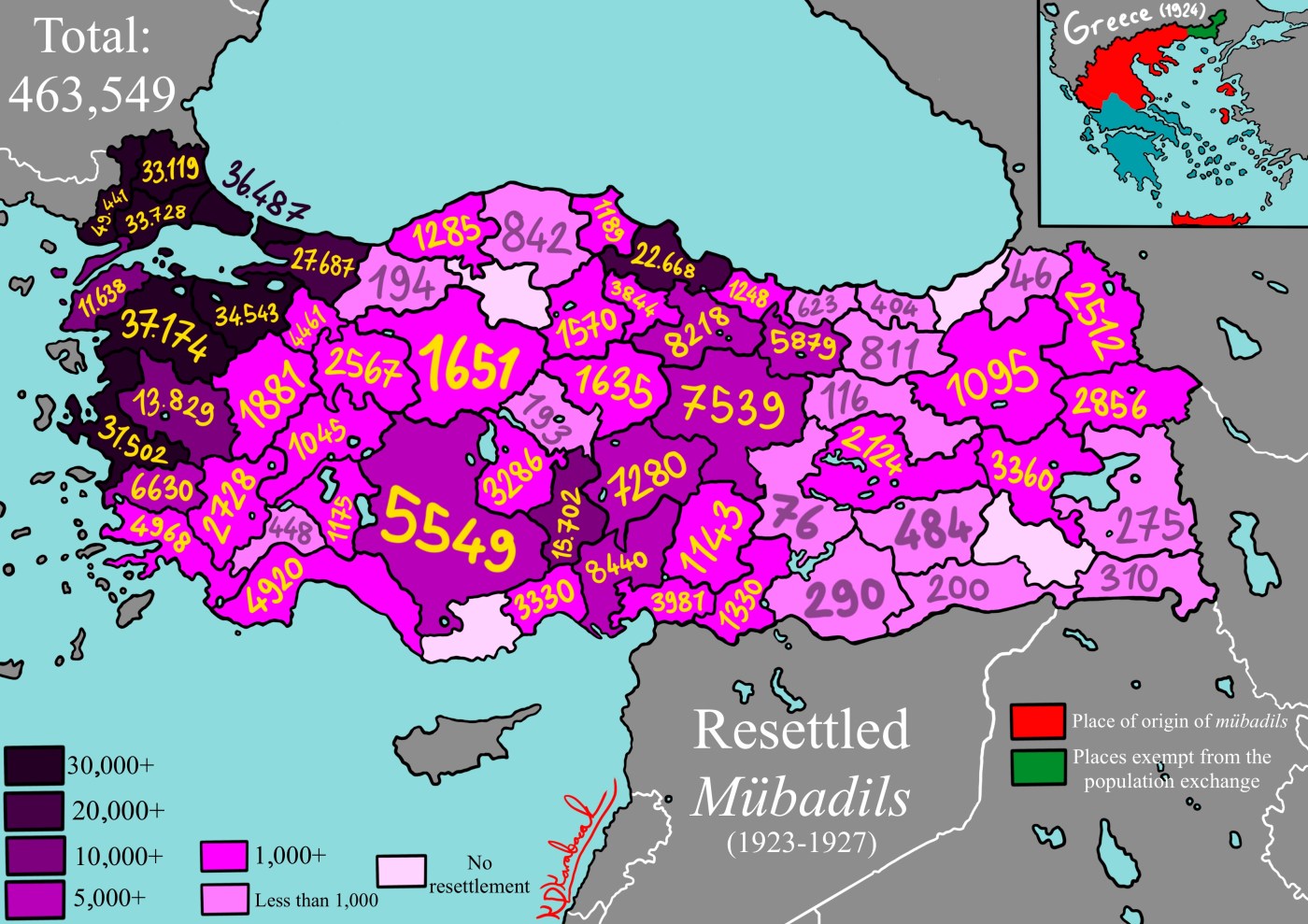
Istanbul occupies a unique position in the history of the Lausanne population exchange. Greeks residing in Istanbul were exempted from the exchange. As a province, Istanbul received the third-largest number of Muslim refugees from Greece. As the former capital of the Ottoman Empire, it also held exceptional symbolic importance. Less known to the global audience, the district of Çatalca, part of Istanbul, also holds great significance both for Turkish history and for the history of the exchange.
Çatalca has long functioned as Istanbul’s natural line of defense. The Roman Emperor Anastasius I (r. 491–518) commissioned massive fortifications in Çatalca, whose remains are still visible today. During the Second World War, Turkey once again constructed a defensive line stretching from the Black Sea to the Sea of Marmara, known as the “Çakmak Line”, named after Marshal Fevzi Çakmak. Earlier, during the Balkan Wars, the collapse of Turkish defences was ultimately halted at Çatalca, halting the Bulgarian advance. Although Çatalca is today the largest district of Istanbul by area, its borders were even more extensive in the past. During the exchange, Turkish authorities sought to deport as many Greeks as possible from Istanbul. To this end, they expanded the borders of Çatalca on the European side and Şile on the Anatolian side as much as they could, and designated them as separate provinces for a period of two years, between 1924 and 1926. As a result, despite being within the boundaries of Istanbul, Çatalca was effectively ‘cleared’ of its Greek population.

Mübadils were settled in fourteen villages of Çatalca. Some of these continued to host the local population, while others were populated exclusively by exchangees. Almost all of those who settled in these villages came from the Neapoli (Nasliç) region of Kozani. For many exchangees from Neapoli, their journey to Türkiye marked the first time they had ever seen the sea. When asked where they wished to be settled upon arrival, they reportedly requested inland areas, fearing that “their children and animals could not swim and might drown.” Çatalca became one of the regions where they were sent. Others were resettled in the provinces of İzmir and Niğde.
Since religion was the decisive criterion of the exchange, these people were required to migrate to Türkiye, even though a significant portion of the exchangees who arrived in Çatalca spoke Greek as their mother tongue. Except for those living in the town centre, almost none of them spoke Turkish. Many first-generation mübadil women in particular never mastered Turkish. While men gradually learned Turkish, those who integrated into urban life or became detached from their families began to forget Greek.
The local population of Çatalca perceived the Greek language spoken by the exchangees as evidence that “one infidel (gavur) had left and another had arrived.”
Meanwhile the local population of Çatalca perceived the Greek language spoken by the exchangees as evidence that “one infidel (gavur) had left and another had arrived,” and consequently took a hostile stance toward them, avoiding intermarriage. This further isolated the exchangees, who had already endured a difficult and traumatic migration process. Due to the late introduction of mass communication tools such as radio into households, limited social interaction, and prevailing prejudices of the period, Greek remained the mother tongue of the majority of Çatalca’s exchangee population until the early 1970s. One way of establishing the size of this community would be to identify individuals recorded as having Greek as their mother tongue and Islam as their religion in censuses conducted between 1927 and 1965.
Although I was raised there, I am neither a ‘native’ of Çatalca nor a descendant of mübadils. Compared to a century ago, in today’s Çatalca there is no longer a clear community divide, or even a coherent identity. As someone who grew up alongside fourth-generation exchangees, I can say that most of my peers are neither aware of, nor particularly concerned with, their past or their identities. During my research for a conference held at JLU Gießen in February 2026, I found that many of the second- and third-generation exchangees I interviewed turned out to be relatives of my school friends, yet I had never known them to be exchangees. Although annual commemorative events related to the exchange are organised in Çatalca, a population exchange museum has been opened, and folk dances are performed, it would not be an exaggeration to say that exchangee identity in Çatalca is on the verge of disappearing unless concrete action is taken.
For my research, I conducted interviews with many second-generation exchangees. They have much to tell. The third generation, unless their professions or personal interests are directly related, generally knows very little. In one of my interviews, I observed a striking duality within the second generation. Scholars who study the population exchange often emphasize a theme of return, assuming that the homeland, especially for the elderly, lies on the other side of the Aegean Sea. However, two neighbouring exchangees from the same generation in the village of Ovayenice hold radically different views. M.C. (b. 1949), despite having visited his ancestral village near Thessaloniki, felt no sense of belonging there. Although he recalls his grandfather and father speaking about the exchange, it neither captured his interest nor did he transmit a mübadil identity to his own children or grandchildren. He never learned Greek and has never considered himself a migrant.
Living just a few houses away, his neighbour and friend G.G. (b. 1960) represents the complete opposite. He learned Greek through his own efforts, has been visiting Greece twice a year since 2014, and has formed many friendships there, his friends in Greece call him “Grigori.” When he travels to Greece, he stays with these friends, and when they visit Turkey, he shows them around Çatalca. Despite never having married or had children, he actively tries to convey the history of the population exchange to the descendants of exchangees and to the broader Turkish public.
This striking contrast is just one example of the sort that leads me to believe that researchers of the population exchange should pay closer attention to Çatalca while the second generation is still alive, so that the opportunity lost with the passing of the first generation is not repeated.
Blogposts are published by TLP for the purpose of encouraging informed debate on the legacies of the events surrounding the Lausanne Conference. The views expressed by participants do not necessarily represent the views or opinions of TLP, its partners, convenors or members.
 The Lausanne Project