
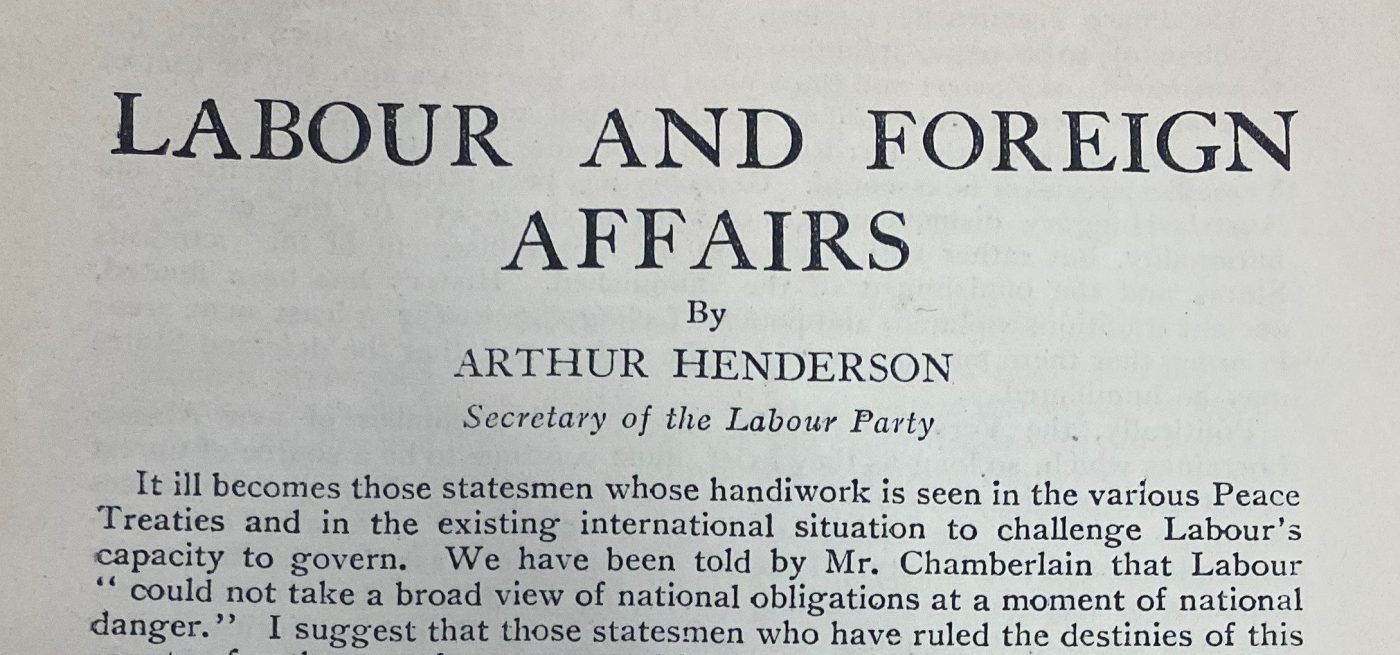

Patrick Boyle considers a key text in the emergence of a British Labour Party foreign policy, published by Arthur Henderson a century ago.
Patrick is a former TLP intern.
“The Peace Treaties have failed,” declared Arthur Henderson, Secretary of the British Labour Party, in the lead up to the Lausanne Conference. [1] His pronouncement, in the pamphlet Labour and Foreign Affairs, reflected the broad pessimism of European labour and socialist parties faced with the “warlike” international system they felt had been reconstituted by the Treaty of Versailles. Key to this disillusionment was the League of Nations’ subservience to the Supreme Allied Council’s will. For Henderson and for much of the Labour Party, the consequences of the peace were all too obvious, and, by 1922, a survey of conditions across Europe, from the Rhineland to Anatolia, justified their pessimism.
The still relatively young Labour Party was rapidly developing a sophisticated foreign policy. The primary forum for this process was the party’s Advisory Committee on International Questions (ACIQ), one of a number of internal party committees Henderson had helped to set up. A committee with loose membership, the ACIQ invited contributions from leading liberal and socialist intellectuals, academics, and politicians on approaches to foreign policy, producing memoranda on a host of international developments. [2] Henderson’s 1923 pamphlet shows the influence of similar publications by other ACIQ attendees, such as Leonard Woolf’s Economic Imperialism (1922), H. N. Brailsford’s After the Peace (1920), and J. A. Hobson’s Imperialism (1902).
Labour and Foreign Affairs reflects the collective effort of a portion of the Labour Party to generate a systematic critique of Allied diplomacy and propose a practicable alternative. It considered punitive reparations placed on Germany and fractious diplomacy with Russia alongside militarism in the Near East and the coercive usage of the mandates system. Largely a repudiation of Lloyd George and Churchill over the Chanak Crisis, Henderson’s pamphlet contains recommendations for the purpose and function of the League of Nations that would, he claimed, nullify conflict in the Near East.
My research into Labour’s interwar foreign policy suggests a wider conception of the League’s function, in organising international relations beyond Europe and “Western Civilisation”. I arrived at this thesis by analysing the tension between Labour’s commitment to anti-imperialism and its support of the mandates system.
Previous historians have claimed that dissenting Labour voices only cared that the League was used for “the appeasement of Germany.” [3] While broadly true, my research on Labour’s interwar foreign policy suggests a wider conception of the League’s function in organising international relations beyond Europe and “Western civilisation”. Initially, I arrived at this thesis by analysing the tension that persisted between Labour’s commitment to anti-imperialism and support for the mandates system. Reviewing Henderson’s pamphlet illustrated that this position was born from attempts to qualify the League as an apparatus that could mollify “capitalist imperialism”, and this had interesting implications for Henderson’s Near East recommendations.
The Treaty of Sèvres is presented as the counterpart to the Treaty of Versailles, a further example of “the policy of spoils for the conquerors,” one where Allied rule was “imposed upon the Constantinople Government against its will” and where the Allies “transferred territory to Greece by right of conquest.” For Henderson, “a spirit of revenge in all Anatolia” was the inevitable consequence of this disregard for the principle of the League Covenant. The injustice extended to the populations in disputed or invaded territory, like Smyrna/Izmir, where residents’ right to self-determination was ignored, reducing “the principle of mandates… to a mockery.” [4]
In Henderson’s view, Allied economic self-interest stood in the way of international conciliation. Inducing a “spirit of conciliation” meant negating the impulses of capitalism – competition, conflict, imperialism – which could only be achieved through a neutral authority. Henderson thus argued that the Straits should be internationalised. Disputed territories in Thrace and across Asia Minor should also be administered by the League of Nations to ensure minority groups were protected. [5] Within his rendering of “minority protection” is a trace of distrust towards the Turks, equally apparent in a 1922 pamphlet by Noel Buxton. “The non-Turkish subjects… have suffered far too much and far too frequently,” Buxton wrote, “to justify further experiments with Turkish reform from within.” [6]

ARTHUR HENDERSON (1863-1935)
Greater League oversight was, however, predicated on the revision of the League’s structure. The League Assembly should be “its sovereign authority”, rather than the Executive Council. Membership should be extended to Germany, Russia, and, potentially, Turkey. Henderson envisaged the Assembly as a parliament, with decisions taken on a democratic basis, thereby curbing the dominance of the Great Powers (Britain, France, Italy). By this logic the League would promote international co-operation, to include a system of collective security guarantees – an idea the first Labour government developed in the Geneva Protocol in 1924, but which was ultimately rejected. [7]
The practical changes Henderson proposed were to be driven by moral force – what he calls “a revolution in the long-established methods of diplomacy.” [8] It is through a moral change that peace would be brought to Europe and, by extension, the Near East. Henderson lays responsibility for the Greek-Turkey war squarely at the door of the Great Powers, but saw the solution there also. One can see in this a hangover of a Gladstonian vision, inculcated by Liberal converts to Labour, that privileges the British Empire as a leading moral agent on the world stage. But this moral force could only be exercised if capitalism was negated.
Henderson’s sketch of the Near East conflict operated as a cautionary tale. The conflict would not have occurred in the same fashion, he claimed, under a Labour administration’s “policy of international co-operation”: of “Open Door” free trade, open diplomacy, and disarmament.
In contrast to the severe reparations that served only to cripple the defeated nations and breed hostility, the “Open Door”, in Henderson’s view, would enable a nation or state’s rehabilitation within a cooperative economic system, one where market access would be monitored by the League. The moral and practical desire to shape the East under the auspices of the League, indicated in Labour and Foreign Affairs, hints to Labour’s mandate policy. The second Labour government of the twentieth century, for example, initiated Iraq’s admission into the League in September 1929, under the assumption that this would at the very least promote Iraq’s political development, bringing an end to British “assistance”. [9]
The 1923 pamphlet also anticipates Henderson’s post-1929 efforts to encourage disarmament at Geneva, first as Foreign Secretary and later as Chair of the Disarmament Conference. By this stage, the moral thrust of Henderson’s foreign policy was to be facilitated by collective security and a sanctions regime. In his view, the sanctity of peaceful relations around the world rested upon codifying the rules on sanctions to enable disarmament, thereby engendering a moral shift in diplomacy which was yet to be secured in Europe. Thus, if “Uncle Arthur” (as he was known by the press in Geneva) believed Lausanne settled peace in the Near East, permanent peace was still to be found in Europe, which remained the focus of his efforts until his death in 1935.
Notes
[1] Arthur Henderson, Labour and Foreign Affairs, (London: The Labour Party, 1923), p. 2.
[2] Henry R. Winkler, Paths Not Taken: British Labour and International Policy in the 1920s, (Chapel Hill: North Carolina UP, 1994), chs. 1 and 3.
[3] A. J. P. Taylor, The Trouble Makers: Dissent Over Foreign Policy, 1792-1939 [1957] (London: Penguin Books, 1985), p. 173.
[4] Henderson, Labour and Foreign Affairs, pp. 5-6.
[5] Ibid., p. 8.
[6] Noel Edward Noel-Buxton, Oppressed Peoples and the League of Nations, (London: J.M. Dent & Sons, 1922), p. 134.
[7] Henderson, Labour and Foreign Affairs, p. 9; Henderson, The New Peace Plan: Labour’s Work at the League of Nations Assembly (London: The Labour Party, 1925).
[8] Henderson, Labour and Foreign Affairs, p.11.
[9] Toby Dodge, Inventing Iraq: The Failure of Nation Building and a History Denied, (New York: Columbia University Press, 2004), pp. 36-40.
.
 The Lausanne Project